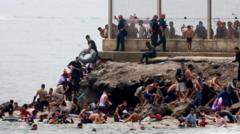
Massive Migrant Crossing: Hundreds Swim to Spanish Ceuta Enclave
Hundreds of migrants swim from Morocco to Spanish enclave of Ceuta, overwhelming local resources. Territorial leader demands Spanish government intervention.
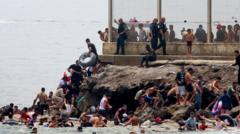
Hundreds of Migrants Undertake Perilous Journey Across Waters to Spanish Enclave
In a significant incident highlighting ongoing migration pressures, hundreds of migrants successfully swam from Morocco to the Spanish enclave of Ceuta in a remarkable feat that has raised serious concerns among local authorities. The migrants swim Morocco Ceuta route remains one of Europe's most challenging and dangerous border crossings, with this latest crossing demonstrating the persistence of irregular migration attempts despite considerable risks and international efforts to regulate movement.
The sheer scale of individuals attempting to reach Spanish territory underscores the desperation many face in North Africa and the continued appeal of Europe as a destination. Officials monitoring the situation have confirmed that the swimmers successfully navigated the waters separating Morocco from the autonomous Spanish city, arriving in significant numbers that have strained the territorial administration's capacity to respond effectively.
Territorial Leadership Raises Alarm Over Resource Strain
The enclave's administration has responded with mounting concern about the sustainability of managing such large-scale arrivals. Local leaders emphasize that infrastructure, accommodation facilities, and social services designed for the resident population are being stretched beyond operational limits. The migrants swim across borders continuously, creating logistical challenges that extend beyond mere border control into broader questions of humanitarian response and administrative capacity.
Officials have characterized the situation as overwhelming, pointing to limitations in screening processes, medical facilities, and temporary housing arrangements. The territorial government argues that the current system cannot adequately handle population surges of this magnitude without compromising service quality for both migrants and existing residents.
Urgent Call for Central Government Intervention
The territory's leadership has issued an emphatic call for the Spanish national government to intervene directly in addressing what they describe as a crisis requiring immediate attention at the highest political levels. Rather than viewing this as a localized issue, officials contend that the migration challenge demands coordinated responses involving national resources, diplomatic engagement with Morocco, and potentially enhanced European Union cooperation mechanisms.
The appeal underscores frustration with current arrangements, where autonomous territories bear substantial responsibility for managing migration flows with limited control over border policies or immigration regulations. Territorial administrators argue that decisions made in Madrid and Brussels fundamentally affect Ceuta's capacity to function, yet the enclave lacks corresponding influence over policy formation.
Context of Migration Pressure Across Spain's African Territories
Ceuta represents one of Spain's two North African enclaves, along with Melilla, both serving as gateways where migration pressures converge. The geographic location makes these territories particularly vulnerable to migration waves, as thousands seek entry into the European Union through Spain's African doorstep. Migration patterns have intensified in recent years, influenced by regional instability, economic disparities, and established migration networks.
The routes across the waters separating Morocco from Spanish territory remain popular despite high risks, including strong currents, hazardous weather conditions, and the physical demands of swimming such distances. Migrants employ various strategies, including swimming in organized groups for collective support and safety, though the approach carries inherent dangers regardless of group size.
Broader Policy Implications and Regional Relations
The incident occurs within a complex framework of Spanish-Moroccan relations, where migration management intersects with diplomatic considerations. Morocco's role in either facilitating or preventing departures remains contentious, with Spanish authorities alternately seeking cooperation and expressing frustration over Morocco's enforcement capabilities or political will.
European Union migration policies increasingly focus on external border management and cooperation with non-EU countries to regulate departures. Spain's enclaves represent prominent test cases for these strategies, where EU border protection meets African migration pressures directly.
Future Outlook and Sustained Challenges
Without substantial policy interventions or changed circumstances driving migration, officials expect continued crossing attempts through various methods. The swimming crossings represent just one approach among multiple strategies migrants employ to reach European territory, including small boat passages, hidden transport in vehicles, and other clandestine means.
The territorial government's appeal for intervention suggests that current management approaches have reached their limits. Whether the Spanish central government implements requested measures, coordinates enhanced responses with Morocco, or pursues alternative policy directions remains to be determined. The situation in Ceuta continues reflecting broader European challenges regarding irregular migration, border security, and humanitarian obligations to vulnerable populations seeking passage into EU territories.